
NON-INVASIVE DIAGNOSTICS.
This device was produced for collecting data from patients in UMMC, Kuala Lumpur and to non-invasively detect dengue. Press the probe to your forearm, and voila! Among others. (W = 6)
This probe was designed to collect skin reflectance profiles, primarily to be used to screen from patients. The design accommodates several optoelectronics components, including a spectrometer.
The project was covered by UM media here.
Here's a bit of history of how we got here. In 2014, our child contracted dengue. Amid the screams when her blood was taken, one wonders: what can we do to alleviate the pains of children in the world?
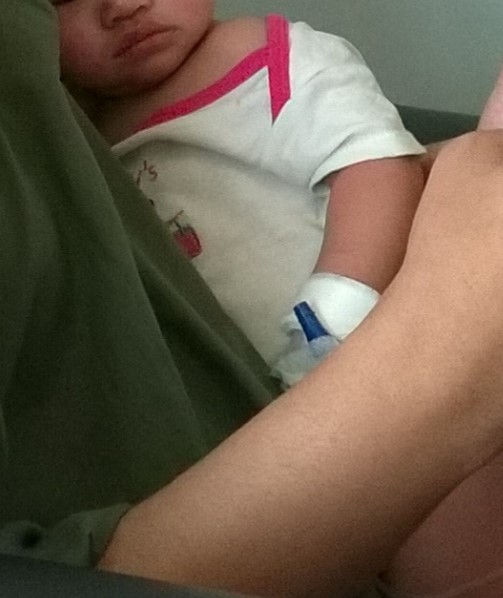
This incident inspired a PhD study and so it began in 2015. With a funding of less than USD1k, an alpha prototype was built. It was a mash-up of spare spectrometers, rented optical equipment, and borrowed equipment. This was the setup which was stationed in UM's hospital in Kuala Lumpur.
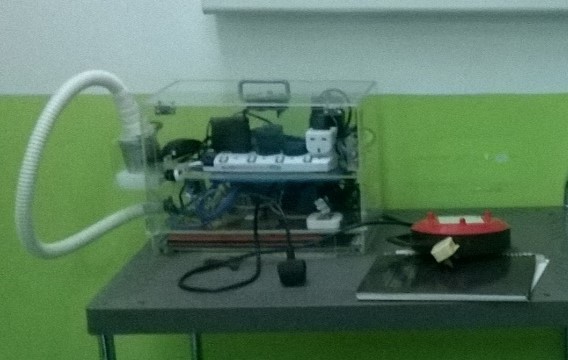
And yes, that's a washing machine hose you're seeing. We needed it to cover the cables leading to the probe used to be prodded on patients' skin. It prevents snagging on other potentially snaggy objects, but aesthetics was the main reason. The results were promising. It looked like it was possible. Anyway, it was published later on in 2020, 5 years after the incident.
It was pretty hard collecting data with a setup that has to be wheeled around like a hospital meal. We even had patients refusing to be recruited due to the scary look of the earlier proto. The old gizmo had to be recalibrated every time, and well... let's just say it doesn't store well.
A new design had to be made, due to obvious limitations. In the end of November 2019, we secured a grant of about $30k USD (RM130k) from KPT and came up with a hand-held probe design.
These are the three prototypes produced. This was done still with limited resources. The bodies were printed in PLA, and painted over. It incorporated a self-calibrating mechanism, a display and wireless capabilities for data collection. It was deployed in UM's hospital again in 2023.
Following the project's relative success, the media team in UM has kindly produced an interview on the project post-expo here.
WHAT NOW?
For now, we're deliberately reiterating and recruiting without being too rushed up. We believe that to do this properly, we need to do this without the noise of the economics. The marketing. The ROIs. CE. MDA. Yes, they're important, no doubt. But we're going to take our time, and take charge.
We're still searching people who might be interested in joining us to develop this further, be it from a technical angle or well... funding.
For those who might be interested, please drop an email: admin@vortex.my or contact us.
- - - - - - - - - - - - - - - - - - - - - - - - - - - - - - - - - - - - - - - - - - - - - - - - - - - - - - - - - - - - - - - - - - - - - - - - - - - - - - - - - - - - - -
These are the three prototypes produced. This was done still with limited resources. The bodies were printed in PLA, and painted over. It incorporated a self-calibrating mechanism, a display and wireless capabilities for data collection. It was deployed in UM's hospital again in 2023.
Following the project's relative success, the media team in UM has kindly produced an interview on the project post-expo here.
WHAT NOW?
For now, we're deliberately reiterating and recruiting without being too rushed up. We believe that to do this properly, we need to do this without the noise of the economics. The marketing. The ROIs. CE. MDA. Yes, they're important, no doubt. But we're going to take our time, and take charge.
We're still searching people who might be interested in joining us to develop this further, be it from a technical angle or well... funding.
For those who might be interested, please drop an email: admin@vortex.my or contact us.
- - - - - - - - - - - - - - - - - - - - - - - - - - - - - - - - - - - - - - - - - - - - - - - - - - - - - - - - - - - - - - - - -
These are the three prototypes produced. This was done still with limited resources. The bodies were printed in PLA, and painted over. It incorporated a self-calibrating mechanism, a display and wireless capabilities for data collection. It was deployed in UM's hospital again in 2023.
Following the project's relative success, the media team in UM has kindly produced an interview on the project post-expo here.
WHAT NOW?
For now, we're deliberately reiterating and recruiting without being too rushed up. We believe that to do this properly, we need to do this without the noise of the economics. The marketing. The ROIs. CE. MDA. Yes, they're important, no doubt. But we're going to take our time, and take charge.
We're still searching people who might be interested in joining us to develop this further, be it from a technical angle or well... funding.
For those who might be interested, please drop an email: admin@vortex.my or contact us.
- - - - - - - - - - - - - - - - - - - - - - - - - - - - - - -
*Note: To aid the viewer's perspective, we added weightage W, followed by a number, which states the estimated number of sub-projects within it.
Usually, one project has several major facets which need to be dealt with separately from the others before they converge as a single. A medical device generally has the most facets due to the multidisciplinary aspects, including embedded programming, electronics, optical alignment, prototyping design and aesthetics, and also interface programming, hence, W = 6.
This highlights that the entries presented are all significant, though not equally so, and that each is distinct.